CWE-862
Allowed-with-ReviewMissing Authorization
Abstraction: Class · Status: Incomplete
The product does not perform an authorization check when an actor attempts to access a resource or perform an action.
14622 vulnerabilities reference this CWE, most recent first.
GHSA-94VP-RMQV-5875
Vulnerability from github – Published: 2020-11-23 19:48 – Updated: 2021-11-19 13:42Impact
An authenticated backend user with the cms.manage_pages, cms.manage_layouts, or cms.manage_partials permissions who would normally not be permitted to provide PHP code to be executed by the CMS due to cms.enableSafeMode being enabled is able to write specific Twig code to escape the Twig sandbox and execute arbitrary PHP.
This is not a problem for anyone that trusts their users with those permissions to normally write & manage PHP within the CMS by not having cms.enableSafeMode enabled, but would be a problem for anyone relying on cms.enableSafeMode to ensure that users with those permissions in production do not have access to write & execute arbitrary PHP.
Patches
Issue has been patched in Build 469 (v1.0.469) and v1.1.0.
Workarounds
Apply https://github.com/octobercms/october/compare/106daa2930de4cebb18732732d47d4056f01dd5b...7cb148c1677373ac30ccfd3069d18098e403e1ca to your installation manually if unable to upgrade to Build 469.
References
Reported by ka1n4t
For more information
If you have any questions or comments about this advisory: * Email us at hello@octobercms.com
Threat assessment:
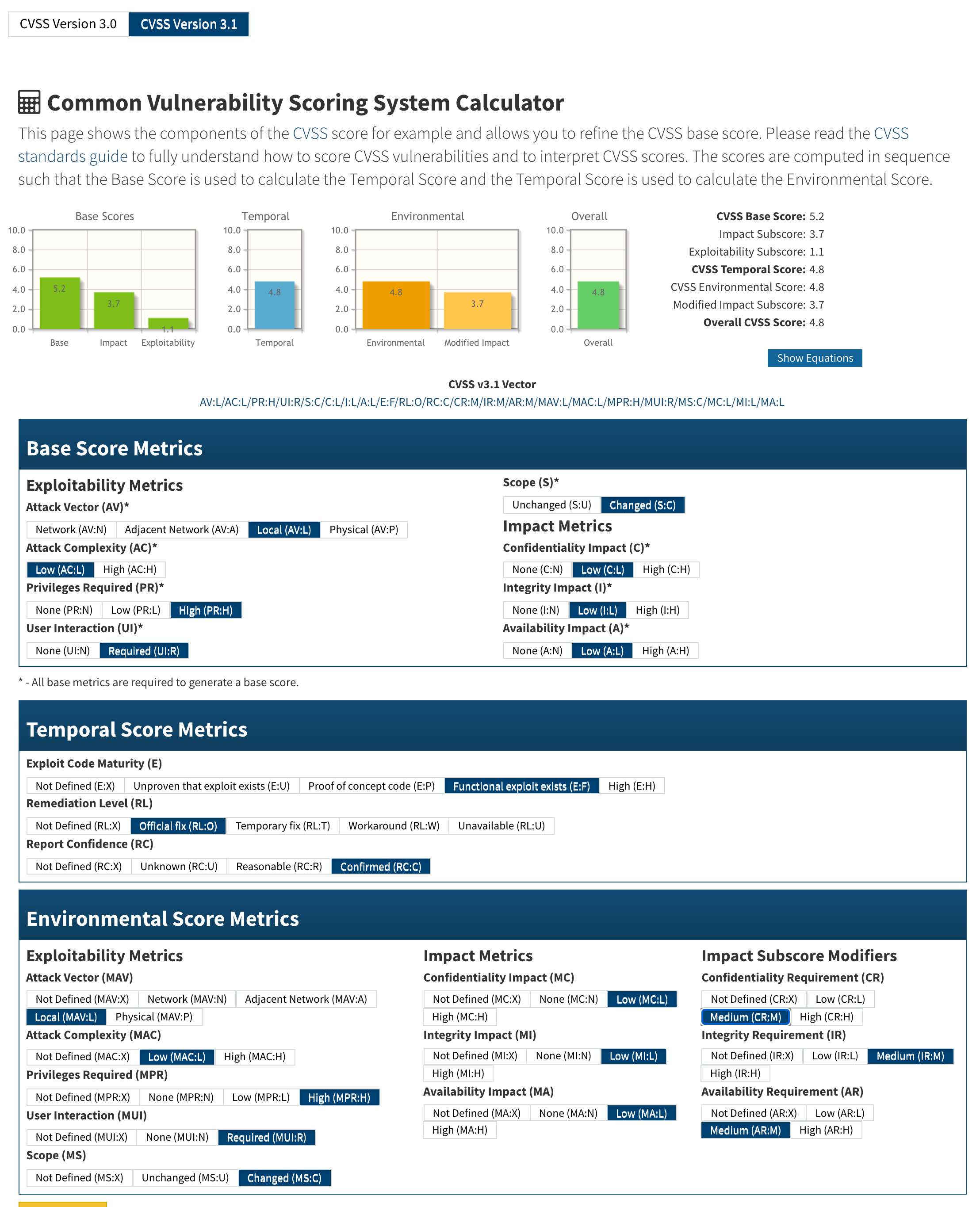
{
  "affected": [
    {
      "package": {
        "ecosystem": "Packagist",
        "name": "october/cms"
      },
      "ranges": [
        {
          "events": [
            {
              "introduced": "1.0.319"
            },
            {
              "fixed": "1.0.469"
            }
          ],
          "type": "ECOSYSTEM"
        }
      ]
    }
  ],
  "aliases": [
    "CVE-2020-15247"
  ],
  "database_specific": {
    "cwe_ids": [
      "CWE-862"
    ],
    "github_reviewed": true,
    "github_reviewed_at": "2020-11-23T19:33:21Z",
    "nvd_published_at": "2020-11-23T20:15:00Z",
    "severity": "MODERATE"
  },
  "details": "### Impact\nAn authenticated backend user with the `cms.manage_pages`, `cms.manage_layouts`, or `cms.manage_partials` permissions who would **normally** not be permitted to provide PHP code to be executed by the CMS due to `cms.enableSafeMode` being enabled is able to write specific Twig code to escape the Twig sandbox and execute arbitrary PHP.\n\nThis is not a problem for anyone that trusts their users with those permissions to normally write \u0026 manage PHP within the CMS by not having `cms.enableSafeMode` enabled, but would be a problem for anyone relying on `cms.enableSafeMode` to ensure that users with those permissions in production do not have access to write \u0026 execute arbitrary PHP.\n\n### Patches\nIssue has been patched in Build 469 (v1.0.469) and v1.1.0.\n\n### Workarounds\nApply https://github.com/octobercms/october/compare/106daa2930de4cebb18732732d47d4056f01dd5b...7cb148c1677373ac30ccfd3069d18098e403e1ca to your installation manually if unable to upgrade to Build 469.\n\n### References\nReported by [ka1n4t](https://github.com/ka1n4t)\n\n### For more information\nIf you have any questions or comments about this advisory:\n* Email us at [hello@octobercms.com](mailto:hello@octobercms.com)\n\n### Threat assessment:\n\u003cimg width=\"1108\" alt=\"Screen Shot 2020-10-10 at 1 21 13 PM\" src=\"https://user-images.githubusercontent.com/7253840/95663316-7de28b80-0afb-11eb-999d-a6526cf78709.png\"\u003e",
  "id": "GHSA-94vp-rmqv-5875",
  "modified": "2021-11-19T13:42:37Z",
  "published": "2020-11-23T19:48:27Z",
  "references": [
    {
      "type": "WEB",
      "url": "https://github.com/octobercms/october/security/advisories/GHSA-94vp-rmqv-5875"
    },
    {
      "type": "ADVISORY",
      "url": "https://nvd.nist.gov/vuln/detail/CVE-2020-15247"
    },
    {
      "type": "WEB",
      "url": "https://github.com/octobercms/october/commit/4c650bb775ab849e48202a4923bac93bd74f9982"
    },
    {
      "type": "PACKAGE",
      "url": "https://github.com/octobercms/october"
    }
  ],
  "schema_version": "1.4.0",
  "severity": [
    {
      "score": "CVSS:3.1/AV:L/AC:L/PR:H/UI:R/S:C/C:L/I:L/A:L",
      "type": "CVSS_V3"
    }
  ],
  "summary": "Twig Sandbox Escape by authenticated users with access to editing CMS templates when safemode is enabled."
}
GHSA-94X4-66R8-CQX9
Vulnerability from github – Published: 2026-06-27 06:30 – Updated: 2026-06-27 06:30The NEX-Forms – Ultimate Forms Plugin for WordPress plugin for WordPress is vulnerable to authorization bypass in all versions up to, and including, 9.2.2. This is due to the plugin not properly verifying that a user is authorized to perform an action. This makes it possible for unauthenticated attackers to enumerate sequential report IDs and download complete form submission data — including names, email addresses, phone numbers, postal addresses, payment details, and uploaded file paths — for any saved report on the site.
{
  "affected": [],
  "aliases": [
    "CVE-2026-12404"
  ],
  "database_specific": {
    "cwe_ids": [
      "CWE-862"
    ],
    "github_reviewed": false,
    "github_reviewed_at": null,
    "nvd_published_at": "2026-06-27T06:16:31Z",
    "severity": "MODERATE"
  },
  "details": "The NEX-Forms \u2013 Ultimate Forms Plugin for WordPress plugin for WordPress is vulnerable to authorization bypass in all versions up to, and including, 9.2.2. This is due to the plugin not properly verifying that a user is authorized to perform an action. This makes it possible for unauthenticated attackers to enumerate sequential report IDs and download complete form submission data \u2014 including names, email addresses, phone numbers, postal addresses, payment details, and uploaded file paths \u2014 for any saved report on the site.",
  "id": "GHSA-94x4-66r8-cqx9",
  "modified": "2026-06-27T06:30:27Z",
  "published": "2026-06-27T06:30:27Z",
  "references": [
    {
      "type": "ADVISORY",
      "url": "https://nvd.nist.gov/vuln/detail/CVE-2026-12404"
    },
    {
      "type": "WEB",
      "url": "https://plugins.trac.wordpress.org/browser/nex-forms-express-wp-form-builder/tags/9.1.12/main.php#L3648"
    },
    {
      "type": "WEB",
      "url": "https://plugins.trac.wordpress.org/browser/nex-forms-express-wp-form-builder/tags/9.1.12/main.php#L3654"
    },
    {
      "type": "WEB",
      "url": "https://plugins.trac.wordpress.org/browser/nex-forms-express-wp-form-builder/tags/9.1.12/main.php#L3792"
    },
    {
      "type": "WEB",
      "url": "https://plugins.trac.wordpress.org/browser/nex-forms-express-wp-form-builder/tags/9.2.2/main.php#L3648"
    },
    {
      "type": "WEB",
      "url": "https://plugins.trac.wordpress.org/browser/nex-forms-express-wp-form-builder/tags/9.2.2/main.php#L3654"
    },
    {
      "type": "WEB",
      "url": "https://plugins.trac.wordpress.org/browser/nex-forms-express-wp-form-builder/tags/9.2.2/main.php#L3792"
    },
    {
      "type": "WEB",
      "url": "https://plugins.trac.wordpress.org/changeset?sfp_email=\u0026sfph_mail=\u0026reponame=\u0026old=3584399%40nex-forms-express-wp-form-builder\u0026new=3584399%40nex-forms-express-wp-form-builder\u0026sfp_email=\u0026sfph_mail="
    },
    {
      "type": "WEB",
      "url": "https://www.wordfence.com/threat-intel/vulnerabilities/id/ecf39f38-a476-47a8-a632-986b851895a6?source=cve"
    }
  ],
  "schema_version": "1.4.0",
  "severity": [
    {
      "score": "CVSS:3.1/AV:N/AC:L/PR:N/UI:N/S:U/C:L/I:N/A:N",
      "type": "CVSS_V3"
    }
  ]
}
GHSA-9559-P8WG-Q54V
Vulnerability from github – Published: 2026-01-07 12:31 – Updated: 2026-01-07 12:31The Moosend Landing Pages plugin for WordPress is vulnerable to unauthorized modification of data due to a missing capability check on the moosend_landings_auth_get function in all versions up to, and including, 1.1.6. This makes it possible for authenticated attackers, with Subscriber-level access and above, to delete the 'moosend_landing_api_key' option value.
{
  "affected": [],
  "aliases": [
    "CVE-2025-13496"
  ],
  "database_specific": {
    "cwe_ids": [
      "CWE-862"
    ],
    "github_reviewed": false,
    "github_reviewed_at": null,
    "nvd_published_at": "2026-01-07T12:16:48Z",
    "severity": "MODERATE"
  },
  "details": "The Moosend Landing Pages plugin for WordPress is vulnerable to unauthorized modification of data due to a missing capability check on the moosend_landings_auth_get function in all versions up to, and including, 1.1.6. This makes it possible for authenticated attackers, with Subscriber-level access and above, to delete the \u0027moosend_landing_api_key\u0027 option value.",
  "id": "GHSA-9559-p8wg-q54v",
  "modified": "2026-01-07T12:31:20Z",
  "published": "2026-01-07T12:31:20Z",
  "references": [
    {
      "type": "ADVISORY",
      "url": "https://nvd.nist.gov/vuln/detail/CVE-2025-13496"
    },
    {
      "type": "WEB",
      "url": "https://plugins.trac.wordpress.org/browser/moosend-landing-pages/tags/1.1.6/forms/auth-request.php#L7"
    },
    {
      "type": "WEB",
      "url": "https://plugins.trac.wordpress.org/browser/moosend-landing-pages/trunk/forms/auth-request.php#L7"
    },
    {
      "type": "WEB",
      "url": "https://www.wordfence.com/threat-intel/vulnerabilities/id/eeb4b3b1-47ae-4314-a386-832949456f81?source=cve"
    }
  ],
  "schema_version": "1.4.0",
  "severity": [
    {
      "score": "CVSS:3.1/AV:N/AC:L/PR:N/UI:N/S:U/C:N/I:L/A:N",
      "type": "CVSS_V3"
    }
  ]
}
GHSA-955J-RV6C-VGF9
Vulnerability from github – Published: 2023-12-04 03:30 – Updated: 2023-12-07 15:30In firewall service, there is a possible way to write permission usage records of an app due to a missing permission check. This could lead to local information disclosure with no additional execution privileges needed
{
  "affected": [],
  "aliases": [
    "CVE-2023-42714"
  ],
  "database_specific": {
    "cwe_ids": [
      "CWE-862"
    ],
    "github_reviewed": false,
    "github_reviewed_at": null,
    "nvd_published_at": "2023-12-04T01:15:10Z",
    "severity": "MODERATE"
  },
  "details": "In firewall service, there is a possible way to write permission usage records of an app due to a missing permission check. This could lead to local information disclosure with no additional execution privileges needed",
  "id": "GHSA-955j-rv6c-vgf9",
  "modified": "2023-12-07T15:30:37Z",
  "published": "2023-12-04T03:30:26Z",
  "references": [
    {
      "type": "ADVISORY",
      "url": "https://nvd.nist.gov/vuln/detail/CVE-2023-42714"
    },
    {
      "type": "WEB",
      "url": "https://www.unisoc.com/en_us/secy/announcementDetail/https://www.unisoc.com/en_us/secy/announcementDetail/1731138365803266049"
    }
  ],
  "schema_version": "1.4.0",
  "severity": [
    {
      "score": "CVSS:3.1/AV:L/AC:L/PR:L/UI:N/S:U/C:H/I:N/A:N",
      "type": "CVSS_V3"
    }
  ]
}
GHSA-9562-R8V7-4W2H
Vulnerability from github – Published: 2025-01-02 12:32 – Updated: 2026-04-01 18:33Missing Authorization vulnerability in AyeCode AyeCode Connect allows Exploiting Incorrectly Configured Access Control Security Levels.This issue affects AyeCode Connect: from n/a through 1.3.8.
{
  "affected": [],
  "aliases": [
    "CVE-2024-56255"
  ],
  "database_specific": {
    "cwe_ids": [
      "CWE-862"
    ],
    "github_reviewed": false,
    "github_reviewed_at": null,
    "nvd_published_at": "2025-01-02T12:15:27Z",
    "severity": "MODERATE"
  },
  "details": "Missing Authorization vulnerability in AyeCode AyeCode Connect allows Exploiting Incorrectly Configured Access Control Security Levels.This issue affects AyeCode Connect: from n/a through 1.3.8.",
  "id": "GHSA-9562-r8v7-4w2h",
  "modified": "2026-04-01T18:33:00Z",
  "published": "2025-01-02T12:32:16Z",
  "references": [
    {
      "type": "ADVISORY",
      "url": "https://nvd.nist.gov/vuln/detail/CVE-2024-56255"
    },
    {
      "type": "WEB",
      "url": "https://patchstack.com/database/wordpress/plugin/ayecode-connect/vulnerability/wordpress-ayecode-connect-plugin-1-3-8-broken-access-control-vulnerability?_s_id=cve"
    }
  ],
  "schema_version": "1.4.0",
  "severity": [
    {
      "score": "CVSS:3.1/AV:N/AC:L/PR:L/UI:N/S:U/C:N/I:L/A:N",
      "type": "CVSS_V3"
    }
  ]
}
GHSA-957M-P4PQ-MXMF
Vulnerability from github – Published: 2026-05-09 06:31 – Updated: 2026-05-14 21:30A missing authorization vulnerability in HCL BigFix WebUI allows an authenticated user without proper permissions to view sensitive environmental information via direct URL access to the unauthorized page.
{
  "affected": [],
  "aliases": [
    "CVE-2025-15634"
  ],
  "database_specific": {
    "cwe_ids": [
      "CWE-862"
    ],
    "github_reviewed": false,
    "github_reviewed_at": null,
    "nvd_published_at": "2026-05-09T06:16:09Z",
    "severity": "MODERATE"
  },
  "details": "A missing authorization vulnerability in HCL BigFix WebUI allows an authenticated user without proper permissions to view sensitive environmental information via direct URL access to the unauthorized page.",
  "id": "GHSA-957m-p4pq-mxmf",
  "modified": "2026-05-14T21:30:37Z",
  "published": "2026-05-09T06:31:36Z",
  "references": [
    {
      "type": "ADVISORY",
      "url": "https://nvd.nist.gov/vuln/detail/CVE-2025-15634"
    },
    {
      "type": "WEB",
      "url": "https://support.hcl-software.com/csm?id=kb_article\u0026sysparm_article=KB0130587"
    }
  ],
  "schema_version": "1.4.0",
  "severity": [
    {
      "score": "CVSS:3.1/AV:N/AC:L/PR:L/UI:N/S:U/C:L/I:N/A:N",
      "type": "CVSS_V3"
    },
    {
      "score": "CVSS:4.0/AV:N/AC:L/AT:N/PR:L/UI:N/VC:L/VI:N/VA:N/SC:N/SI:N/SA:N/E:X/CR:X/IR:X/AR:X/MAV:X/MAC:X/MAT:X/MPR:X/MUI:X/MVC:X/MVI:X/MVA:X/MSC:X/MSI:X/MSA:X/S:X/AU:X/R:X/V:X/RE:X/U:X",
      "type": "CVSS_V4"
    }
  ]
}
GHSA-9582-7XGQ-XHQ8
Vulnerability from github – Published: 2025-08-12 15:31 – Updated: 2025-08-12 15:31Missing authorization in the admin console of Ivanti Virtual Application Delivery Controller before version 22.9 allows a remote authenticated attacker to take over admin accounts by resetting the password
{
  "affected": [],
  "aliases": [
    "CVE-2025-8310"
  ],
  "database_specific": {
    "cwe_ids": [
      "CWE-862"
    ],
    "github_reviewed": false,
    "github_reviewed_at": null,
    "nvd_published_at": "2025-08-12T15:15:31Z",
    "severity": "MODERATE"
  },
  "details": "Missing authorization in the admin console of Ivanti Virtual Application Delivery Controller before version 22.9 allows a remote authenticated attacker to take over admin accounts by resetting the password",
  "id": "GHSA-9582-7xgq-xhq8",
  "modified": "2025-08-12T15:31:20Z",
  "published": "2025-08-12T15:31:20Z",
  "references": [
    {
      "type": "ADVISORY",
      "url": "https://nvd.nist.gov/vuln/detail/CVE-2025-8310"
    },
    {
      "type": "WEB",
      "url": "https://forums.ivanti.com/s/article/August-Security-Advisory-Ivanti-Virtual-Application-Delivery-Controller-vADC-previously-vTM-CVE-2025-8310?language=en_US"
    }
  ],
  "schema_version": "1.4.0",
  "severity": [
    {
      "score": "CVSS:3.1/AV:N/AC:L/PR:N/UI:R/S:U/C:N/I:H/A:N",
      "type": "CVSS_V3"
    }
  ]
}
GHSA-9589-R2JC-QP9J
Vulnerability from github – Published: 2022-08-13 00:00 – Updated: 2022-08-17 00:00In SELinux policy, there is a possible way of inferring which websites are being opened in the browser due to a missing permission check. This could lead to local information disclosure with no additional execution privileges needed. User interaction is not needed for exploitation.Product: AndroidVersions: Android-13Android ID: A-166269532
{
  "affected": [],
  "aliases": [
    "CVE-2022-20340"
  ],
  "database_specific": {
    "cwe_ids": [
      "CWE-862"
    ],
    "github_reviewed": false,
    "github_reviewed_at": null,
    "nvd_published_at": "2022-08-12T15:15:00Z",
    "severity": "LOW"
  },
  "details": "In SELinux policy, there is a possible way of inferring which websites are being opened in the browser due to a missing permission check. This could lead to local information disclosure with no additional execution privileges needed. User interaction is not needed for exploitation.Product: AndroidVersions: Android-13Android ID: A-166269532",
  "id": "GHSA-9589-r2jc-qp9j",
  "modified": "2022-08-17T00:00:33Z",
  "published": "2022-08-13T00:00:45Z",
  "references": [
    {
      "type": "ADVISORY",
      "url": "https://nvd.nist.gov/vuln/detail/CVE-2022-20340"
    },
    {
      "type": "WEB",
      "url": "https://source.android.com/security/bulletin/android-13"
    }
  ],
  "schema_version": "1.4.0",
  "severity": [
    {
      "score": "CVSS:3.1/AV:L/AC:L/PR:L/UI:N/S:U/C:L/I:N/A:N",
      "type": "CVSS_V3"
    }
  ]
}
GHSA-959V-HPG2-3F7W
Vulnerability from github – Published: 2024-04-29 12:30 – Updated: 2026-04-28 21:35Missing Authorization vulnerability in WPOmnia KB Support.This issue affects KB Support: from n/a through 1.6.0.
{
  "affected": [],
  "aliases": [
    "CVE-2024-33589"
  ],
  "database_specific": {
    "cwe_ids": [
      "CWE-862"
    ],
    "github_reviewed": false,
    "github_reviewed_at": null,
    "nvd_published_at": "2024-04-29T11:15:46Z",
    "severity": "MODERATE"
  },
  "details": "Missing Authorization vulnerability in WPOmnia KB Support.This issue affects KB Support: from n/a through 1.6.0.",
  "id": "GHSA-959v-hpg2-3f7w",
  "modified": "2026-04-28T21:35:00Z",
  "published": "2024-04-29T12:30:36Z",
  "references": [
    {
      "type": "ADVISORY",
      "url": "https://nvd.nist.gov/vuln/detail/CVE-2024-33589"
    },
    {
      "type": "WEB",
      "url": "https://patchstack.com/database/vulnerability/kb-support/wordpress-kb-support-plugin-1-6-0-broken-access-control-vulnerability?_s_id=cve"
    }
  ],
  "schema_version": "1.4.0",
  "severity": [
    {
      "score": "CVSS:3.1/AV:N/AC:L/PR:L/UI:N/S:U/C:H/I:N/A:N",
      "type": "CVSS_V3"
    }
  ]
}
GHSA-95C6-28C3-2PJC
Vulnerability from github – Published: 2026-02-03 15:30 – Updated: 2026-02-12 15:32Missing Authorization vulnerability in WP Chill Passster content-protector allows Exploiting Incorrectly Configured Access Control Security Levels.This issue affects Passster: from n/a through <= 4.2.25.
{
  "affected": [],
  "aliases": [
    "CVE-2026-25036"
  ],
  "database_specific": {
    "cwe_ids": [
      "CWE-862"
    ],
    "github_reviewed": false,
    "github_reviewed_at": null,
    "nvd_published_at": "2026-02-03T15:16:21Z",
    "severity": "MODERATE"
  },
  "details": "Missing Authorization vulnerability in WP Chill Passster content-protector allows Exploiting Incorrectly Configured Access Control Security Levels.This issue affects Passster: from n/a through \u003c= 4.2.25.",
  "id": "GHSA-95c6-28c3-2pjc",
  "modified": "2026-02-12T15:32:42Z",
  "published": "2026-02-03T15:30:27Z",
  "references": [
    {
      "type": "ADVISORY",
      "url": "https://nvd.nist.gov/vuln/detail/CVE-2026-25036"
    },
    {
      "type": "WEB",
      "url": "https://patchstack.com/database/Wordpress/Plugin/content-protector/vulnerability/wordpress-passster-plugin-4-2-25-broken-access-control-vulnerability?_s_id=cve"
    }
  ],
  "schema_version": "1.4.0",
  "severity": [
    {
      "score": "CVSS:3.1/AV:N/AC:L/PR:L/UI:N/S:U/C:H/I:N/A:N",
      "type": "CVSS_V3"
    }
  ]
}
Mitigation
- Divide the product into anonymous, normal, privileged, and administrative areas. Reduce the attack surface by carefully mapping roles with data and functionality. Use role-based access control (RBAC) [REF-229] to enforce the roles at the appropriate boundaries.
- Note that this approach may not protect against horizontal authorization, i.e., it will not protect a user from attacking others with the same role.
Mitigation
Ensure that access control checks are performed related to the business logic. These checks may be different than the access control checks that are applied to more generic resources such as files, connections, processes, memory, and database records. For example, a database may restrict access for medical records to a specific database user, but each record might only be intended to be accessible to the patient and the patient's doctor [REF-7].
Mitigation MIT-4.4
Strategy: Libraries or Frameworks
- Use a vetted library or framework that does not allow this weakness to occur or provides constructs that make this weakness easier to avoid.
- For example, consider using authorization frameworks such as the JAAS Authorization Framework [REF-233] and the OWASP ESAPI Access Control feature [REF-45].
Mitigation
- For web applications, make sure that the access control mechanism is enforced correctly at the server side on every page. Users should not be able to access any unauthorized functionality or information by simply requesting direct access to that page.
- One way to do this is to ensure that all pages containing sensitive information are not cached, and that all such pages restrict access to requests that are accompanied by an active and authenticated session token associated with a user who has the required permissions to access that page.
Mitigation
Use the access control capabilities of your operating system and server environment and define your access control lists accordingly. Use a "default deny" policy when defining these ACLs.
CAPEC-665: Exploitation of Thunderbolt Protection Flaws
An adversary leverages a firmware weakness within the Thunderbolt protocol, on a computing device to manipulate Thunderbolt controller firmware in order to exploit vulnerabilities in the implementation of authorization and verification schemes within Thunderbolt protection mechanisms. Upon gaining physical access to a target device, the adversary conducts high-level firmware manipulation of the victim Thunderbolt controller SPI (Serial Peripheral Interface) flash, through the use of a SPI Programing device and an external Thunderbolt device, typically as the target device is booting up. If successful, this allows the adversary to modify memory, subvert authentication mechanisms, spoof identities and content, and extract data and memory from the target device. Currently 7 major vulnerabilities exist within Thunderbolt protocol with 9 attack vectors as noted in the Execution Flow.